


Russian reflexive verbs play an essential role in expressing actions that the subject performs on itself. These verbs are characterized by their distinctive endings, typically -ся or -сь, which signal this reflexive nature. Understanding their conjugation and use in various contexts is vital for effective communication. However, distinguishing between reflexive and non-reflexive verbs can be challenging. Exploring these nuances reveals deeper insights into the language and its cultural implications.
What Are Reflexive Verbs in Russian?
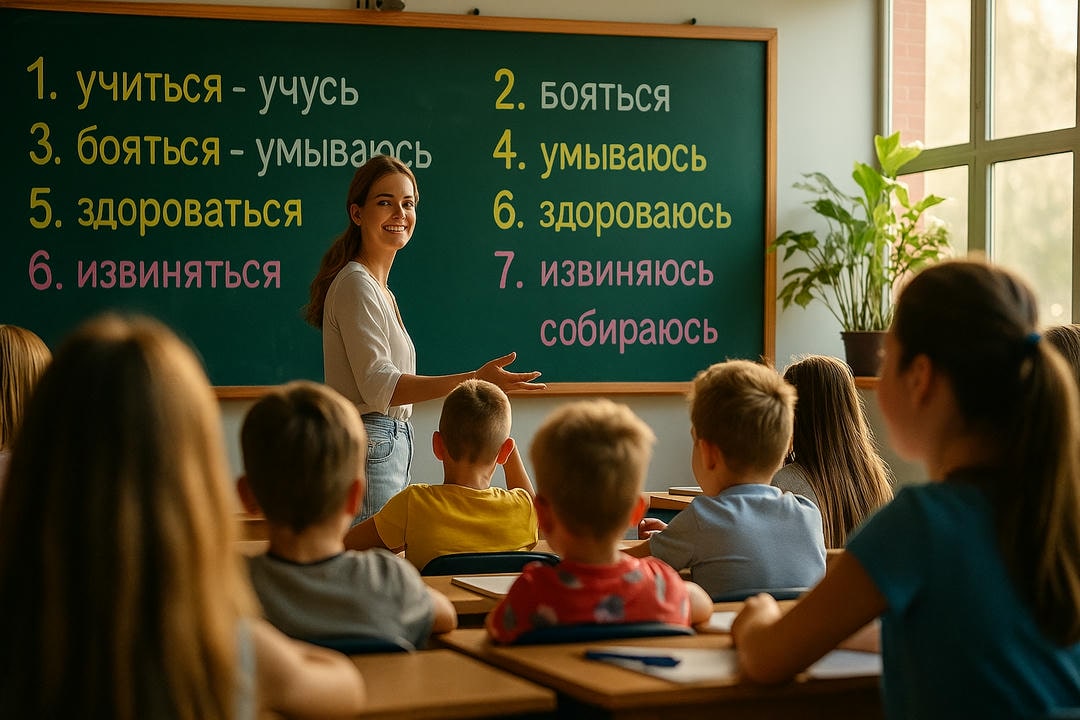
Reflexive verbs in Russian serve a distinct grammatical purpose, indicating that the subject of the verb performs an action upon itself. This unique aspect of reflexive verb usage reveals cultural nuances inherent in the Russian language.
Reflexive constructions often emphasize the relationship between the subject and the action, suggesting a degree of introspection or self-directed activity. For instance, verbs like “мыться” (to wash oneself) convey not just the action but also the personal involvement of the subject.
Understanding these verbs requires awareness of their specific forms and contexts, which can vary considerably from non-reflexive counterparts. Mastery of reflexive verbs enriches one’s command of the language, allowing for more nuanced communication and expression of individual agency within Russian cultural frameworks.

How to Identify Reflexive Verbs in Russian
Identifying reflexive verbs is an important step for English speakers learning Russian. Reflexive verbs in Russian indicate that the subject of the verb is also the receiver of the action, similar to saying “myself” or “yourself” in English. The most noticeable sign of a reflexive verb is its ending: reflexive verbs always end with -ся or -сь.
Key Features of Reflexive Verbs
1. Morphological Marker: -ся / -сь
- Almost all reflexive verbs attach -ся (after a consonant) or -сь (after a vowel or in some forms) to the verb.
- This ending is added to the infinitive and conjugated forms.
Examples:
- Мыться (to wash oneself)
- Одеваться (to dress oneself)
- Учиться (to study/learn [for oneself])
- Смяться (to laugh)
2. Non-Reflexive vs. Reflexive Pairs
Often, a verb can exist in both reflexive and non-reflexive forms, with the reflexive form having a different meaning.
| Non-Reflexive | Reflexive | English Translation |
|---|---|---|
| одевать (odevat’) | одеваться | to dress / to get dressed |
| мыть (myt’) | мыться | to wash / to wash oneself |
| учить (uchit’) | учиться | to teach / to learn |
| встречать (vstrechat’) | встречаться | to meet / to meet each other |
3. Contextual Use
Some verbs may look reflexive but are idiomatic or have specialized meanings that do not translate directly as reflexive in English. For example:
- бояться (to be afraid)
- казаться (to seem)
These verbs always appear in the reflexive form, even though their meaning might not be “reflexive” in the English sense.
Common Reflexive Verb Endings
| Ending | When Used | Example |
|---|---|---|
| -ся | After a consonant | мыться |
| -сь | After a vowel (or soft sign) | боюсь |
Related Russian Terms
| Russian (Cyrillic) | Phonetic | English Definition |
|---|---|---|
| глагол | glagol | verb |
| возвратный глагол | vozvratnyi glagol | reflexive verb |
| суффикс | suffiks | suffix |
| личное местоимение | lichnoe mestoimenie | personal pronoun |
| себя | sebya | oneself |
| действие | deystvie | action |
| подлежащее | podlezhashchee | subject |
| объект | ob’ekt | object |
To identify reflexive verbs in Russian:
- Look for the endings -ся or -сь.
- Compare with non-reflexive forms to see if the meaning changes.
- Be aware of idiomatic uses where the verb always appears reflexively.
Familiarity with these patterns and terms will make it easier to recognize and use reflexive verbs correctly in Russian.
Conjugating Reflexive Verbs in Russian
Conjugating reflexive verbs in Russian is a key skill for learners, as these verbs are very common in everyday speech. Reflexive verbs indicate that the subject is performing an action on itself or for its own benefit. In Russian, they are easy to spot because they end in -ся (after consonants) or -сь (after vowels).
1. Structure of Reflexive Verbs
A reflexive verb in its infinitive form is made by adding the suffix -ся to the verb. For example:
- мыть (to wash) → мыться (to wash oneself)
- одевать (to dress) → одеваться (to dress oneself)
2. Conjugation Patterns
Reflexive verbs follow the same conjugation rules as non-reflexive verbs, except you add the reflexive suffix at the end:
Example with “мыться” (to wash oneself):
| Person | Non-reflexive | Reflexive |
|---|---|---|
| я (I) | мою | моюсь |
| ты (you, sing.) | моешь | моешься |
| он/она/оно (he/she/it) | моет | моется |
| мы (we) | моем | моемся |
| вы (you, pl.) | моете | моетесь |
| они (they) | моют | моются |
3. Tense Variations
The reflexive suffix -ся/-сь does not change with tense. The root changes as usual for present, past, and future tenses.
Present:
- Он умывается.
He washes himself.
Past:
- Он умывался.
He washed himself.
Future:
- Он будет умываться.
He will wash himself.
4. Subject Agreement
As with all Russian verbs, the ending must agree with the subject in both person and number. The reflexive suffix is always attached to the end of the conjugated verb.
5. Aspectual Distinction
Russian verbs have two aspects: imperfective (ongoing/repeated actions) and perfective (completed actions). Reflexive verbs exist in both aspects:
- одеваться (imperfective — to be getting dressed)
- одеться (perfective — to get dressed)
Use the aspect that matches what you want to express.
6. Related Russian Terms
| Russian (Cyrillic) | English Phonetic | English Definition |
|---|---|---|
| мыться | myt’-sya | to wash oneself |
| умываться | umyvat’-sya | to wash one’s face/hands |
| одеваться | odevat’-sya | to get dressed |
| раздеваться | razdevat’-sya | to get undressed |
| смеяться | smeyat’-sya | to laugh |
| бояться | boyat’-sya | to be afraid |
| заниматься | zanimat’-sya | to study, to be occupied with |
| встречаться | vstrechat’-sya | to meet (with someone) |
| начинаться | nachinat’-sya | to begin, to start (itself) |
| заканчиваться | zakanchivat’-sya | to finish, to end (itself) |
By understanding these patterns and terms, you’ll gain a solid foundation for using reflexive verbs accurately in Russian.
Common Reflexive Verbs and Their Meanings
Understanding reflexive verbs is a key step for English speakers learning Russian. Reflexive verbs in Russian are marked by the suffix “-ся” or “-сь” and indicate that the subject is performing the action on themselves. This feature is quite prevalent in Russian and can often change the meaning of a verb significantly.
Reflexive verbs show that the subject both performs and receives the action. In Russian, these verbs are easily identifiable because they end with “-ся” (after a consonant or non-vowel ending) or “-сь” (after a vowel).
For example:
- мыть (to wash) → мыться (to wash oneself)
- одевать (to dress someone) → одеваться (to dress oneself)
Reflexive verbs are used for daily routines, emotions, and processes that naturally involve the subject.
Why Are Reflexive Verbs Important?
- Personal Involvement: They express actions involving the subject’s own body, emotions, or state.
- Cultural Insight: Some verbs reflect values such as self-care and self-responsibility, important in Russian culture.
- Conversational Utility: Many common expressions, especially about daily routines and feelings, require reflexive verbs.
Below is a table of frequently used Russian reflexive verbs. Each entry includes the verb in Cyrillic, its English phonetic transcription, and its English meaning.
| Russian (Cyrillic) | Phonetic (English) | English Meaning |
|---|---|---|
| мыться | myt’-sya | to wash oneself |
| одеваться | o-de-vat’-sya | to get dressed |
| раздеваться | raz-de-vat’-sya | to undress |
| умываться | u-my-va-t’-sya | to wash one’s face/hands |
| причёсываться | pri-chyo-sy-va-t’-sya | to comb/brush one’s hair |
| бриться | brit’-sya | to shave oneself |
| просыпаться | pro-sy-pa-t’-sya | to wake up |
| ложиться спать | la-zhi-tsa spat’ | to go to bed |
| чувствовать себя | chuv-stvo-vat’ se-bya | to feel (oneself) |
| смеяться | smeyat’-sya | to laugh |
| улыбаться | u-ly-ba-t’-sya | to smile |
| бояться | ba-yat’-sya | to be afraid |
| волноваться | vol-no-va-t’-sya | to worry |
| интересоваться | in-te-re-so-va-t’-sya | to be interested in |
| заниматься | za-ni-ma-t’-sya | to be occupied with/to study |
| встречаться | vstre-cha-t’-sya | to meet (with someone), to date |
| прощаться | pro-shcha-t’-sya | to say goodbye |
| знакомиться | zna-ko-mit’-sya | to get acquainted |
| заботиться | za-bo-ti-t’-sya | to take care of |
Notes on Usage
- Many reflexive verbs have non-reflexive counterparts with different meanings.
- Some verbs are always reflexive, while others can be used both ways depending on the context.
- Using reflexive verbs correctly makes your Russian sound more natural and helps you express actions more precisely.
Familiarity with these common reflexive verbs will greatly improve your ability to discuss routines, feelings, and social interactions in Russian.
Reflexive Verbs in Different Contexts
Reflexive verbs in Russian play an important role that goes far beyond simply indicating actions one does to oneself. Their usage is rich and versatile, adding nuance and specificity to everyday speech. Here’s a deeper look into the main contexts where reflexive verbs appear, along with essential Russian words and phrases:
1. Self-care (Уход за собой)
Reflexive verbs are commonly used to describe daily routines and personal hygiene. In these contexts, they indicate that the subject is performing the action on themselves. Typical verbs include:
- мыться (to wash oneself)
- одеваться (to get dressed)
- причесываться (to comb one’s hair)
- бриться (to shave)
For example, “Я умываюсь утром” (I wash my face in the morning) clearly shows the action is directed at the speaker.
2. Reciprocal Actions (Взаимные действия)
Reflexive verbs can emphasize that an action is mutual or reciprocal, involving two or more people interacting with each other. This use often appears with plural subjects:
- встречаться (to meet each other)
- обниматься (to hug each other)
- целоваться (to kiss each other)
- переписываться (to correspond with each other)
For instance, “Они встретились в парке” means “They met each other in the park,” highlighting the mutual nature of the action.
3. Emotional Expressions (Эмоциональные состояния)
Describing internal states, feelings, or reactions is another key role of reflexive verbs. These often express changes in mood or condition:
- волноваться (to worry)
- смущаться (to feel embarrassed)
- радоваться (to rejoice, be glad)
- сердиться (to get angry)
Such verbs often convey a subjective experience, as in “Она расстроилась” (She became upset).
4. Impersonal Constructions (Безличные конструкции)
Sometimes, reflexive verbs help create impersonal sentences—statements that are general and not tied to a specific subject. These are especially useful for describing things that happen generally or habitually:
- считаться (it is considered)
- думается (one thinks)
- читается (it reads, as in ‘the book reads easily’)
An example would be “Здесь не курится” (Smoking is not allowed here), where the statement applies broadly rather than to a specific person.
Additional Notes on Russian Reflexive Verbs:
In Russian, reflexive verbs usually end with “-ся” or “-сь” after a vowel. The reflexive particle can change the meaning of the base verb significantly, so it’s important to learn them as separate vocabulary items. Notably, some verbs exist only in reflexive form (бояться—to be afraid), while others have both reflexive and non-reflexive versions with different meanings (учить—to teach vs. учиться—to study/learn).
Mastering these patterns helps you sound more natural and precise in Russian, reflecting everything from everyday routines to abstract feelings and social interactions.
Differences Between Reflexive and Non-Reflexive Verbs

Reflexive and non-reflexive verbs play distinct roles in Russian grammar, and understanding their differences is key for expressing actions accurately.
Reflexive verbs are easily recognized by their endings: “-ся” (after consonants) or “-сь” (after vowels). These endings are attached to the verb and indicate that the subject is both doing and receiving the action. In other words, the subject acts upon itself. For example, the verb “мыться” (to wash oneself) shows that the person is washing their own body. Other common reflexive verbs include:
- одеваться — to get dressed (literally, to dress oneself)
- учиться — to study, to learn (oneself)
- бриться — to shave oneself
- бояться — to be afraid (reflexive form expresses a state that affects the subject)
Reflexive verbs are not limited to physical actions—they can also express feelings, changes of state, or mutual actions. For instance:
- смеяться — to laugh
- надеяться — to hope
- встретиться — to meet (with someone, mutually)
In contrast, non-reflexive verbs do not have the “-ся” ending and typically describe actions directed toward another object or person. For example:
- мыть — to wash (something or someone)
- одевать — to dress (someone else)
- учить — to teach or to learn (something, not oneself)
- брить — to shave (someone else)
These verbs focus on the action being performed on an external object rather than on the subject itself.
Key points:
- Reflexive verbs change the focus of the action so that it circles back to the subject.
- Non-reflexive verbs direct the action outward to another person or object.
- The reflexive suffix “-ся/-сь” can also change the meaning of a verb significantly. For example:
- закрывать — to close (something)
- закрываться — to close (itself), as in “The shop closes at 7 p.m.”
Useful Russian terms and phrases:
- Возвратные глаголы (reflexive verbs)
- Невозвратные глаголы (non-reflexive verbs)
- Суффикс -ся / -сь (the suffix -ся / -сь)
- Действие, направленное на себя (action directed at oneself)
- Действие, направленное на другого (action directed at another)
Being able to distinguish between reflexive and non-reflexive forms will help you avoid misunderstandings and sound more natural when speaking Russian. It also allows you to express nuances, such as whether an action is personal, reciprocal, or directed at someone else. Many verbs in Russian come in both reflexive and non-reflexive pairs, each with its own shade of meaning, making this topic especially important for learners.
Tips for Practicing Reflexive Verbs
Practicing reflexive verbs in Russian requires a strategic approach to effectively internalize their unique structures and meanings. To enhance mastery, learners should engage in focused practice exercises and interactive language games. These methods not only reinforce understanding but also promote retention.
- Utilize flashcards to memorize reflexive verb forms and their meanings.
- Participate in role-playing scenarios that incorporate reflexive verbs in context.
- Regularly write short paragraphs using reflexive verbs to facilitate practical application.
Reflexive Verbs in Russian: Usage, Examples, and Key Terms
Reflexive verbs are a fundamental aspect of Russian grammar, often marked by the suffix -ся or -сь attached to the verb. These verbs indicate that the subject performs an action on itself, rather than on someone else. Understanding how reflexive verbs function in sentences helps learners communicate actions related to personal care, emotions, routines, and reciprocal actions.
How Reflexive Verbs Work
The reflexive ending -ся (after consonants) or -сь (after vowels) is added to the infinitive form of the verb:
- мыть (to wash) → мыться (to wash oneself)
- готовить (to prepare) → готовиться (to prepare oneself)
Reflexive verbs are not limited to personal hygiene; they appear in many contexts, including feelings, reciprocal actions, and passive constructions.
Common Uses of Reflexive Verbs
- Personal care and routines
- Он моется.
(He washes himself.) - Я одеваюсь.
(I get dressed.)
- Он моется.
- Preparing or getting ready
- Она готовится к экзамену.
(She prepares for the exam.) - Мы собираемся в поездку.
(We are getting ready for the trip.)
- Она готовится к экзамену.
- Expressing feelings or states
- Я боюсь темноты.
(I am afraid of the dark.) - Они смеются.
(They are laughing.)
- Я боюсь темноты.
- Reciprocal actions (when two or more people do something to each other)
- Они встречаются каждый день.
(They meet each other every day.)
- Они встречаются каждый день.
List of Common Reflexive Verbs in Russian
| Russian (Cyrillic) | Pronunciation | English Definition |
|---|---|---|
| мыться | [my-tsa] | to wash oneself |
| одеваться | [a-de-va-tsa] | to get dressed |
| раздеваться | [raz-de-va-tsa] | to undress |
| готовиться | [ga-to-vi-tsa] | to prepare oneself |
| бояться | [ba-yat’-sa] | to be afraid |
| улыбаться | [u-ly-ba-tsa] | to smile |
| смеяться | [sme-yat’-sa] | to laugh |
| встречаться | [vstre-chat’-sa] | to meet each other |
| прощаться | [pra-shchat’-sa] | to say goodbye |
| заниматься | [za-ni-ma-tsa] | to study, to engage in |
| учиться | [u-chit’-sa] | to study, to learn |
| интересоваться | [in-te-re-so-va-tsa] | to be interested (in) |
| останавливаться | [as-ta-nav-li-va-tsa] | to stop oneself |
Key Points for English Speakers
- The reflexive suffix (-ся / -сь) is essential and changes the meaning of the verb.
- Some verbs are only used in reflexive form in Russian and do not directly translate to a reflexive form in English.
- Reflexive verbs often appear in daily conversation, so recognizing them is crucial for comprehension and speaking.
By practicing with these examples and familiarizing yourself with common reflexive verbs, you can build confidence in using them correctly in various contexts.
Frequently Asked Questions
Are Reflexive Verbs Used in Formal Russian Writing?
Reflexive verbs are indeed employed in formal Russian writing, showcasing varied writing styles. Their usage conveys nuanced meanings, enhancing clarity and precision, essential for conveying complex ideas while maintaining the freedom of expression within formal contexts.
How Do Reflexive Verbs Affect Sentence Structure?
Reflexive verbs influence sentence construction by altering verb placement, often positioning the reflexive pronoun directly after the verb. This structure emphasizes the action’s relationship to the subject, enhancing clarity and precision in communication.
Can Reflexive Verbs Have Non-Reflexive Counterparts?
Reflexive verb forms often possess non-reflexive equivalents, allowing for nuanced expression. This distinction enables speakers to convey actions directed at oneself or others, enhancing clarity in communication and providing flexibility in sentence construction.
Are There Regional Variations in Using Reflexive Verbs?
Regional variations in the usage of reflexive verbs often exhibit distinct dialect differences. These variations may influence verb forms, meanings, and conjugations, highlighting the complexities of language and the cultural nuances inherent in regional speech patterns.
What Are Common Mistakes When Using Reflexive Verbs?
Common mistakes include misunderstanding meanings associated with reflexive verbs and incorrect conjugation. These errors can lead to miscommunication, hindering clarity in expression. A thorough understanding of context is essential for accurate usage in conversation.